

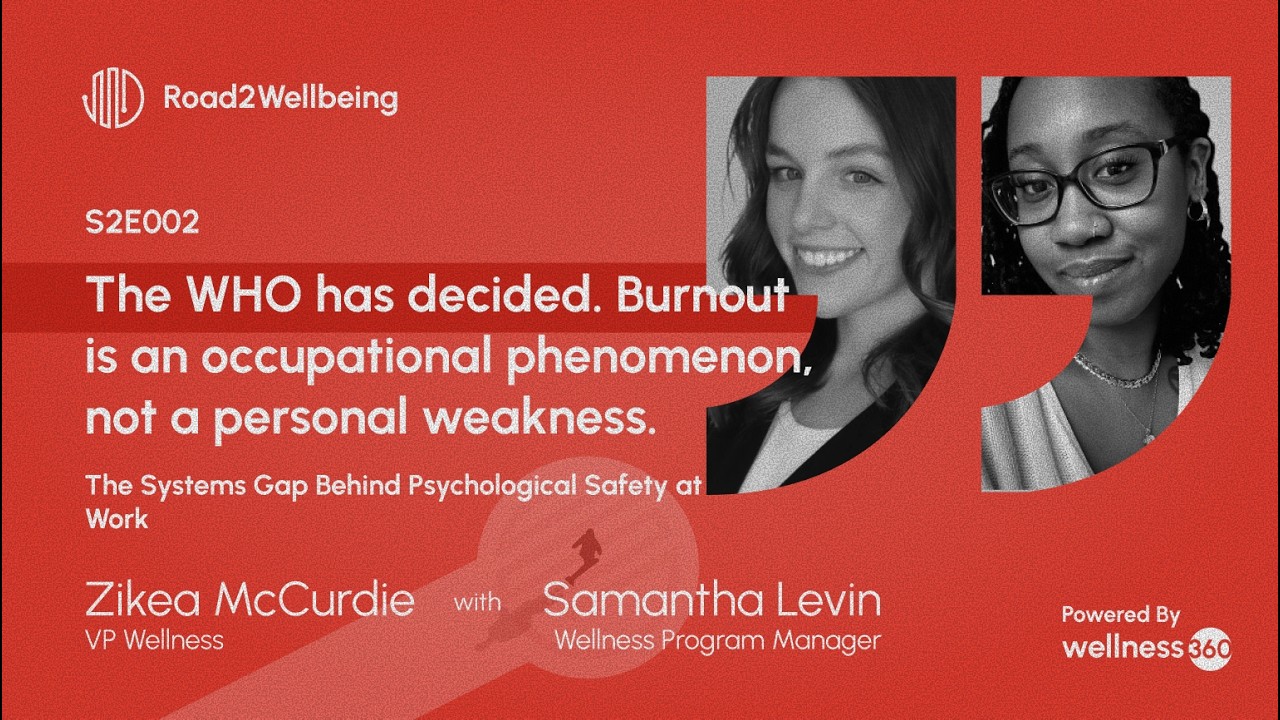
1. The WHO has decided. Burnout is an occupational phenomenon, not a personal weakness. The Systems Gap Behind Psychological Safety at Work | S2-E002
Your weekly listens from Road2Wellbeing Podcast, Helping HR Leaders Guide Their Workforce to Wellness
72% of employees are currently dealing with moderate to very high stress at work, a six-year high, and more than half reported active burnout in the last year alone.
An overview
Burnout, as defined by the WHO, is a syndrome resulting from chronic workplace stress that has not been successfully managed, presenting across three clinical dimensions:
- energy depletion and exhaustion,
- increased psychological distance from one’s work or cynicism, and
- reduced professional efficacy.
For years, organizational responses defaulted to individual-level interventions, asking employees to manage their stress, practice more self-care, or attend a yoga class, while leaving untouched the structural conditions generating the crisis. Work overload, cited by 47% of workers as a primary stressor, is compounded by understaffing, poor leadership communication, lack of recognition, and external pressures bleeding in from personal finance and global events.
What makes this particularly costly is the silence it produces: 62% of employees who felt uncomfortable disclosing mental health struggles at work reported being actively burned out, and 46% said they feared losing their job if they raised the issue, meaning the populations most at risk are the least likely to signal it.
What we discuss
- Why the World Health Organization officially classifies burnout as an occupational phenomenon, not a personal weakness, and what that reclassification demands of employers
- What the three clinical dimensions of burnout are, and how to use them to distinguish burnout from disengagement before misreading the signal costs you the employee
- How burned-out employees and disengaged employees can look similar behaviorally, and why the response to each needs to be different
- Why work overload and staffing gaps account for the majority of top burnout stressors, and how leaders often fail to see accumulation in real time
- What psychological safety actually requires beyond stated policy, and why consistent behavior over time is the only mechanism that builds it
- Why employees who experience a genuine sense of belonging at work are 23% less likely to burn out, and how belonging is built through small, repeated acts of inclusion rather than programs or mandates
- How fear of professional consequences keeps 46% of employees from disclosing mental health struggles even when support is theoretically available
- What the gap between manager training and manager readiness looks like when an employee is clearly not okay
- What immediate actions HR leaders can take this week, including anonymous pulse checks, calendar audits for overload, and modeling vulnerability in one-on-ones
Referenced in this episode
- Wellness360: Enterprise wellness platform offering whole-health programming across all dimensions of employee wellbeing wellness360.co
- World Health Organization (WHO): International public health authority; referenced for the clinical definition of burnout as an occupational syndrome and its formal classification as a workplace phenomenon, not a personal weakness who.int
Listen to this episode and more on https://www.wellness360.co/podcasts/road2wellbeing-s2e002/
Drop a topic you would like us to cover!
2. Wellness terms Straight from the Experts
100% human-written. Real opinions from Wellness360 practitioners on wellness stipends, conflict resolution, and biometric screening.
i) The Wellness Stipend Playbook: What to Include, What to Exclude, and What Your Employees Won’t Tell You
https://blog.wellness360.co/wellness-stipend-playbook/
Most stipend programs either give employees too much freedom or none at all. Samantha Levin covers what actually belongs in a well-designed program — and the unspoken needs employees have but will never raise their hand to ask for.
ii) Conflict Resolution at Work: The Skill Nobody Checks for But Every Team Needs
https://blog.wellness360.co/conflict-resolution-at-work/
85% of employees face workplace conflict. Most leaders do nothing — or worse, reward the wrong person. Samantha Levin on why open-door policies fail in practice, and what actually works.
iii) Biometric Screening Done Right: The Clinical, Legal, and Engagement Playbook for Employers
https://blog.wellness360.co/biometric-screening-done-right/
Biometric screening isn’t just a blood draw. Samantha Levin, Wellness Manager at Wellness360, breaks down what to measure, what to do with the results, and why most programs fail before the data even lands.
Brought to you by — Wellness360, an NCQA-accredited, HiTrust-r2 certified, enterprise wellness platform built on the 8 Pillars of Wellness. Bringing you clinical depth and seamless HRIS integration while recording upto 70% sustained employee engagement.

